Critical minerals a potential bargaining chip for US-Ukraine security guarantees

The United States and Ukraine are exploring a deal that would grant the US access to Ukraine’s critical mineral reserves in return for continued military and financial support
This week, US Treasury Secretary Scott Bessent travelled to Kyiv, where he reportedly presented a draft economic cooperation agreement to Ukrainian President Volodymyr Zelensky. The proposal, part of a US-backed plan to end the war in Ukraine, includes provisions on critical minerals.
“As with Greenland, President Trump is trying to secure US access to the various critical mineral deposits essential for defence industrial supply chains,” said Bryan Bille, policy and geopolitical analyst at Benchmark.
President Trump has suggested access to ‘$500 billion’ worth of critical minerals as a potential prerequisite for US security guarantees – particularly rare earth elements (REEs), which are essential for strategic military hardware. The US is highly vulnerable to China’s near-monopoly on global REE supply.
“However, much like Greenland, little mining is taking place, and the business case for mining in Ukraine is challenging, given the ongoing war and current Russian occupation in mineral-rich zones,” Bille added.
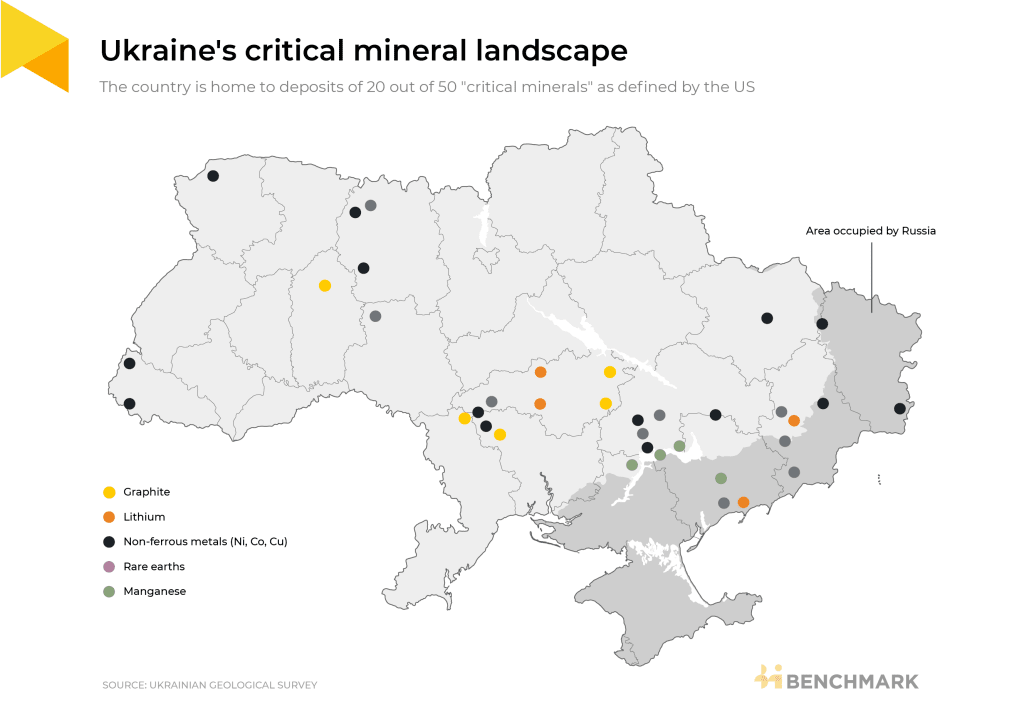
According to the Kyiv School of Economics, the country holds one-third of Europe’s lithium reserves and 3% of the world’s total, along with 6% of the world’s explored graphite reserves. However, an estimated 20-40% of Ukraine’s mineral resources, including up to half of its rare earth deposits, are under Russian occupation.
Ukraine’s critical mineral landscape
Despite its mineral wealth, Ukraine’s critical minerals sector remains largely undeveloped due to the ongoing war and long-standing political instability. Although the country has significant REE deposits, Benchmark data indicates that there are no active mines or deposits currently under development.
Ukraine is home to two early-stage hard-rock lithium projects. The Shevchenkivske project, the country’s largest lithium deposit, is located in the Donetsk region, which is under Russian control. A second project, the Polokhivske and Dobra deposits, is situated in central Ukraine.
Meanwhile, Ukraine’s only operational flake graphite asset, the Zavalievsky Plant in the Kirovograd region, halted production in December 2024 due to a lack of investment and challenging market conditions. A second project in the same region is progressing through its early development stages, having completed a pre-feasibility study in early 2025.
The country has also been home to several manganese ore mines since the Soviet era – but production has been stopped since 2023 due to electricity and labour shortages.
Ukraine looks to foreign investment
According to reports, Ukrainian officials have been pitching access to the country’s critical mineral deposits to entice President Trump to retain American support since last year. A consortium led by US-government backed TechMet has been engaged with Kyiv regarding a bid for a lithium deposit in the region.
Foreign direct investment will be key to rebuilding Ukraine’s shattered economy and the government has enacted reforms to streamline regulatory approvals in the mining sector, in the hope that it will create the necessary prerequisites to attract investment.
However, significant barriers to investment remain. Not least that developing deposits in a geo-politically unstable region will be a multi-year undertaking with limited immediate economic benefits for investors.
At Giga USA 2025, taking place 3-4 June in Washington, D.C., we will be joined by policymakers shaping critical legislation, industry leaders spearheading innovation, and investors fuelling domestic growth, united in the mission to strengthen the North American battery supply chain.
Register nowwith our Super Early Bird offer, available until 22nd March.
 >
>  >
>  >
>  >
>  >
>  >
>  >
>  >
>