National security top of mind during Benchmark Week Day 1

Benchmark Week 2025 kicked off in LA on Tuesday, with policy makers, industry leaders, and experts from Benchmark discussing the key topics impacting energy transition supply chains in 2025.
From across the first day’s sessions three key takeaways emerged:
1. Supply chains are a national security priority now more than ever
“These are not just industries being driven by the uptake of electric vehicles, what it’s really about now is national security,” Andrew Miller, Benchmark’s chief executive remarked during his keynote address.

Benchmark CEO Andrew Miller delivers his keynote address. Photo credit: Jens Reiterer
The thread ofnational securitywas woven into nearly every panel. Critical mineral supply chain policies no longer emphasise the need for a green energy transition, but instead focus on how they can support defence applications, reduce reliance on foreign entities, and prioritise national interests.
Rare earths are a vital mineral in defence applications as well as EV motors, and China’s use ofexport controls to restrict trade flowsposed a major issue for the West, especially the US.
“There was no major US based OEM that wasn’t impacted by the rare earth export controls imposed by China earlier this year,” Tara Berrie, Rivian’s director of battery cell materials and rare earth sourcing, told attendees.
2. Localisation and vertical integration are key
Linked to national security is the need to reduce dependency on other nations, especially those with hegemonic control ofkey supply chains. As such, localisation and vertical integration came up repeatedly throughout the day.
“The current US administration is focused on developing critical mineral supply chains, in fact they are looking at building out the entire battery value chain,” said David Park, the CEO ofStandard Lithium.
Beyond supporting the national interest, localised supply chains can offer other benefits such as reducing material lead times, managing exposure to raw material price swings, and creating leaner, more agile operations.
“We are looking at any possible way to bring our supply chains closer to us,” said Thomas Fickett, Chief Financial Officer at Panasonic Energy of North America.

Panasonic Energy of North America’s CFO Thomas Fickett talks to Benchmark’s COO Caspar Rawles. Photo credit: Jens Reiterer
3. Energy storage is an emerging demand drive
The battery story has, until recently, been heavily focused on electric vehicles. In part, this is due to the emphasis on the emission reductions EVs can enable. But, increasinglyenergy storageis taking up morespace in the conversation, with a clear link between energy security and national security.
Energy storage projectsare getting bigger, with an increasing number of giga-scale projects. And it isn’t just lithium ion battery energy storage that is getting bigger: earlier this month US-basedsodium ionbattery developer Peak Energy signed a 4.75 GWh contract with ESS operator Jupiter Power for deployment between 2027 and 2030.
“With electricity demand climbing again,battery storageis emerging as the most flexible way to safeguard reliability andenergy security,” Benchmark’s Head of Research Iola Hughes told delegates. “In this new era of growth, battery storage equals energy security and is being treated as a key lever across federal, state, and industry priorities.”
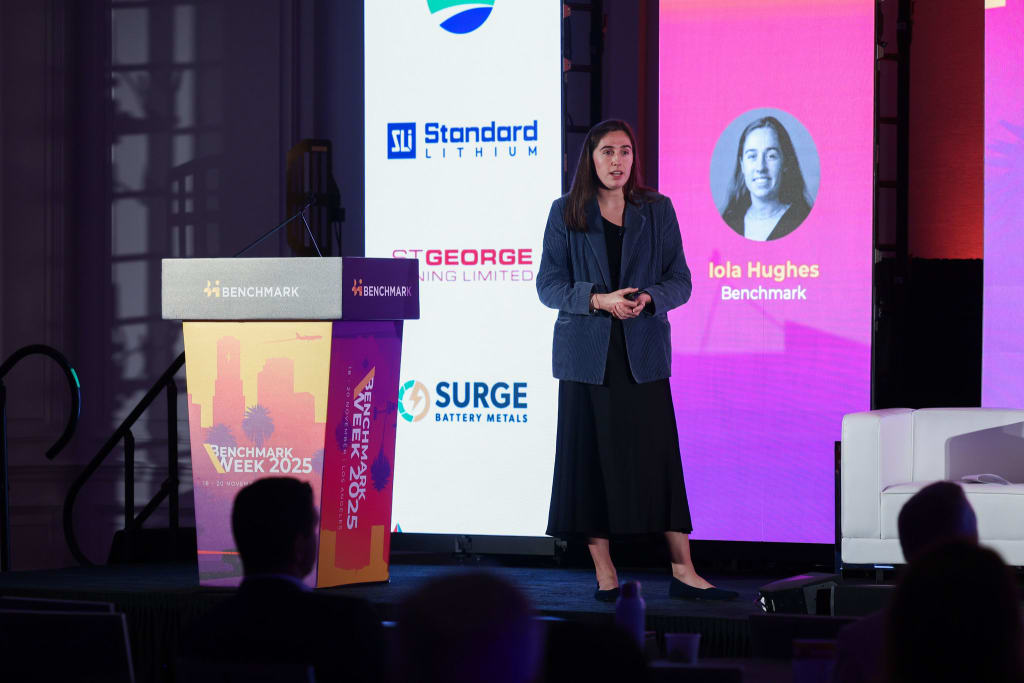
Benchmark’s Head of Research Iola Hughes presents about rising demand from energy storage. Photo credit: Jens Reiterer
To learn more about Benchmark’s services, please fill in the form below and one of the team will be in touch:
 >
>  >
>  >
>  >
>  >
>  >
>  >
>  >
>