How do Europe’s energy storage incentives compare to the USA’s IRA?

The US threw down an incentive-laden gauntlet when it launched the Inflation Reduction Act last year.
Europe has a range of energy storage incentives, but none of them are at the same scale as the IRA, meaningEurope could be losing outas itshomegrown companies move across the pond.
In the US, these incentives are already being utilised. The first example of a standalone energy storage project using the credits came online earlier this year in Texas.
“The IRA is really changing the pace,” Julian Jansen, growth and market development director at energy storage provider Fluence, told attendees at Solar Media’s Energy Storage Summit last month. “There is a really easy-to-access incentive.”
IRA credits
Prior to the Inflation Reduction Act, energy storage developers could get tax credits towards the cost of a system, but only if the storage was directly linked to a solar project.
Now,energy storage developerscan get investment tax credits worth up to 30% of the cost of installing a system. A bonus 10% is available if the project uses entirely domestic iron and steel and if two-fifths of the manufactured products used are domestically sourced. A further 10% bonus is available for projects developed in so-called energy communities.
The first project not linked to a solar project to make use of these credits is operated by Eolian, an energy projects portfolio company. Eolian began operation of its 200-megawatt, multi-hour battery energy storage facility in Texas in February this year and will be fully operational later in the year.
European incentives
European countries have also developed a wide range of incentive schemes toencourage the development of energy storage.
“Italy, Portugal, Ireland have set up interesting incentives regarding behind-the-meter storage,” Lidia Tamellini, a policy officer at the European Association for Storage of Energy (EASE), told Benchmark. “So-called Superbonus in Italy focused on tax rebates, an interesting grid fees framework for self-consumption in Portugal, and the Irish Microgeneration Support Scheme.”
Spain also has incentives for energy storage deployment. In December last year, the Spanish government announced a €150 million (US$161 million) scheme through which it will cover between 40% and 65% of the investment cost of energy storage systems over 1 MWh with at least two hours of storage. However, unlike the US, these projects must be co-located with power generation, through a shared grid connection.
The latest Spanish project to access this subsidy package is Enel Green’s €33 million 30 MW / 60 MWh battery storage project colocated with a 44 MW solar storage project in Badajoz, Extremadura.
Competing with the IRA
Despite efforts from European countries, the scale of the incentives can’t compete with the might, and pulling power, of the USA’s IRA.
Pomega, a Turkish energy storage and cell developer, plans for its energy storage systems (ESS) factory in Ankara, Turkey to begin operations later this year. But it also recently broke ground on anLFP plantin the US. The size of this plant was increased from two to three GWh in light of the incentives available through the IRA.
“IRA incentives were thorough, strong and solid, and we need to emphasise that they are helping a lot to realise our investment,” Kontrolmatik Technologies, the parent company of Pomega, told Benchmark.
“Europe is forecasted to only make up 11% of the ESS market over the next decade whilst North America is expected to make up around 20% of the market,” Aran Waid, an analyst at Benchmark, said. “This is due to there being greater grid deployments in the US on account of the IRA which is pushing investment towards larger scale projects thanks to the investment and production tax credits on offer.”
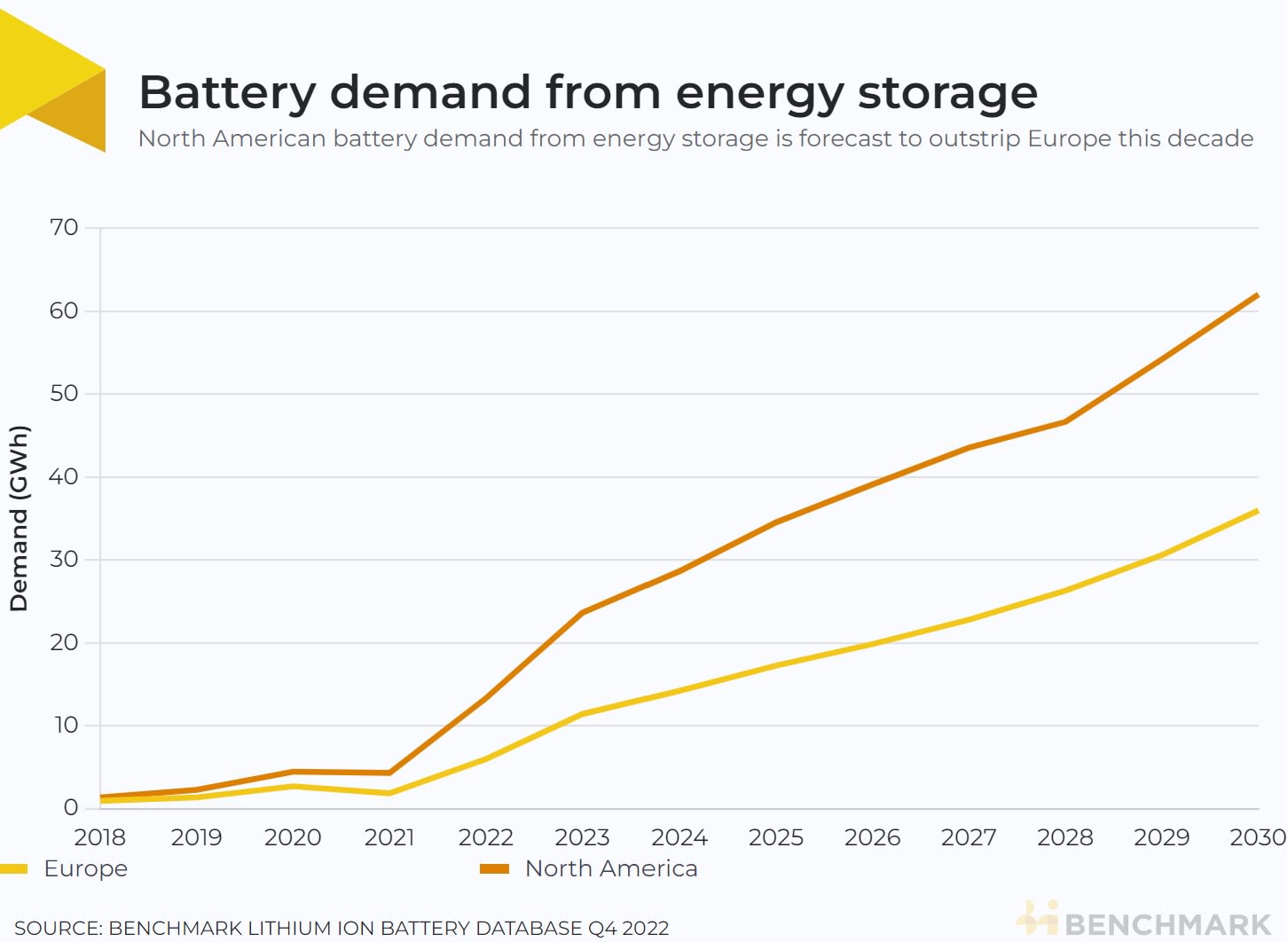
“The EU can and ‘should be able to’ compete with similar incentives such as IRA’s,” Kontrolmatik Technologies said. “However, if the EU wants to compete with both US and China, they should act faster.”
Later this month, the EU is expected to release its response to the IRA in the form of theGreen Deal Industrial Planand Net-Zero Industry Act. As yet, it is unclear what the scale of the incentives for energy storage will be.
Plan beyond incentives
Although incentives are important, they won’t always be there. Many IRA tax credits associated with energy storage will be in place until at least 2033, with some phasing out four years after the US’s greenhouse emissions fall to 25% or less than the emissions in 2022.
“Subsidies don’t tend to make good business models,” Pablo Otin, co-founder of solar developer Powertis, said at the Energy Storage Summit. “You want to make sure it works long-term.”
 >
>  >
>  >
>  >
>  >
>  >
>  >
>  >
>