EU courts Greenland for critical raw materials amid Arctic geopolitical shifts

The European Union (EU) is eyeing Greenland as a key strategic partner as it advances plans to develop Europe-focused raw material value chains and reduce reliance on China.
The bloc signed a Memorandum of Understanding (MoU) with Greenland for a strategic partnership to develop sustainable raw materials value chains in November 2023; a bilateral cooperation that seeks to develop Greenland’s mining sector in a manner that adheres to the EU’ssustainability standards.
“Given the geostrategic interests and the battery mineral endowments in Greenland, it makes sense for the EU to deepen the raw material and geopolitical relationship with Greenland,” said Bryan Bille, principal policy analyst at Benchmark.
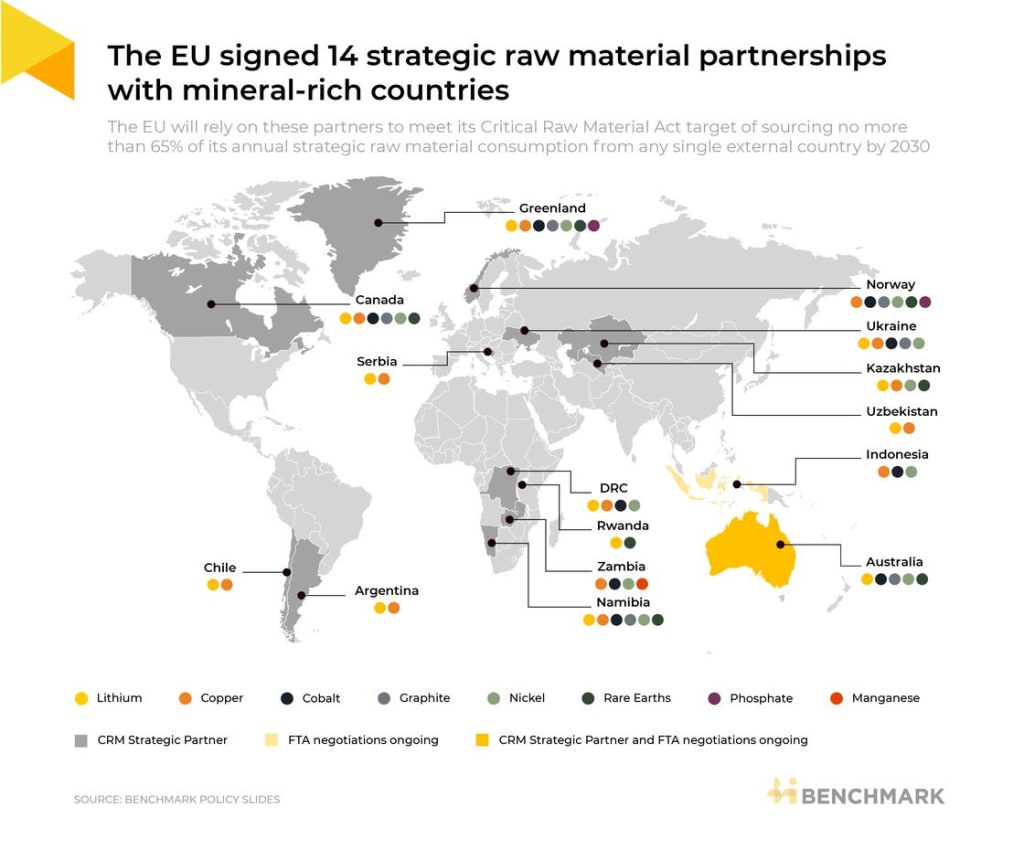
As an autonomous Danish territory, Greenland is not part of the EU and possesses autonomy over domestic affairs such as mineral exploration and extraction rights. Denmark, meanwhile, retains rights over the territory’s foreign policy and defence.
The EU Commission opened an office in Greenland’s capital, Nuuk, in March 2024, simultaneously launching a Green Growth program to invest €22.5 million in energy and critical raw materials value chains in the region.
“Despite some progress, we haven’t yet seen a roadmap since the MoU was signed in November last year, although the two sides intended to agree on one within six months,” Bille added.
Greenland’s critical raw material potential
A 2023 reported published by the Geological Survey of Denmark and Greenland (GEUS) recognised that 25 of the 34 of the minerals covered under the European Comission’s ‘critical raw materials’ were present in Greenland, including significant endowments of battery minerals such as graphite and lithium, as well as the rare earth elements (REE) utilised in clean technologies such as electric vehicles and wind turbines.
GEUS identified 6 Mt of known natural graphite resources, 36.1 Mt of known REE resources, 235kt of known lithium resources, and 106kt of known copper resources.
Aside from the potential for local pushback, the development of mining projects in Greenland will also be challenging due to its remoteness, harsh climate, limited workforce, and lack of infrastructure. The EU will need to assist in alleviating some of these barriers to entry if it hopes to attract private investment for large-scale mining operations in the region.
But Greenland does offer a stable political climate and a broadly pro-mining government keen to diversify its economy – making it a more attractive partner compared to some other resource-rich nations.
Greenland and the geopolitics of the Arctic
The EU’s motivation for deepening economic and political ties with Greenland also lie in a desire to anchor the island’s economy towards Europe and away from China and Russia, amidst intensifying geopolitical competition in the Arctic region.
An independence movement in Greenland has steadily gained momentum in recent years, with the government presenting a first draft of a constitution in 2023. The possibility of full autonomy from Denmark poses several economic and security implications for the EU and its allies, while also adding risk for potential mining investments in the region.
“The geopolitics involved could make future mining investments more risky and complex. Hence, the importance of the EU-Greenland strategic partnership, which should be aimed at derisking these investments,” Bille said.
As polar ice caps continue to disappear, new opportunities for resource extraction and emerging trade routes in the Arctic are enhancing Greenland’s strategic importance as a gateway to the region.
China has previously expressed interest in Greenland’s raw material resources, pledging to build a “Polar Silk Road” – although China has failed as yet to gain a significant foothold in the region. Russia, meanwhile, is increasingly asserting its military presence in the Arctic region, with regional cooperation all but disappearing following the full-scale invasion of Ukraine in 2022.
Greenland, therefore, sits at the intersection of several overlapping strands of geopolitical competition and the EU will hope it can use bilateral cooperation to strengthen its position in the region.
Policy developments in the EU, including recent election results, will play a key role in shaping European critical mineral and battery industries.
Join Benchmark’s webinar on Thursday 26 September at 07:00 or 15:00 (GMT+1) as our experts examine the question –What Would Political Change in Europe Mean for the Energy Transition?
Register with your business email addresshere.
 >
>  >
>  >
>  >
>  >
>  >
>  >
>  >
>