Europe leads on board gender diversity in lithium mining

Lithium mining companies operating or developing in Europe have stronger gender diversity at the board level than other regions, according toBenchmark’s Lithium Sustainability Index.
Of the 24 lithium mining companies with projects in Europe that disclose their board members, there is an average of 26% female representation. This compares to a 13% global average.
“Balance in boards responsible for major decision-making at companies is not only essential from a Diversity and Inclusion perspective, but reports demonstrate how diverse boards ultimately have a positive impact on company performance,” Sarah Colbourn, Acting Head of Sustainability at Benchmark, said. “Gender diversity at board level sets the tone for the business more broadly.”
Europe accounted for just 0.2% of global mined lithium production in 2023, according toBenchmark’s Lithium Forecast. This is set to grow to 3.2% by 2030.
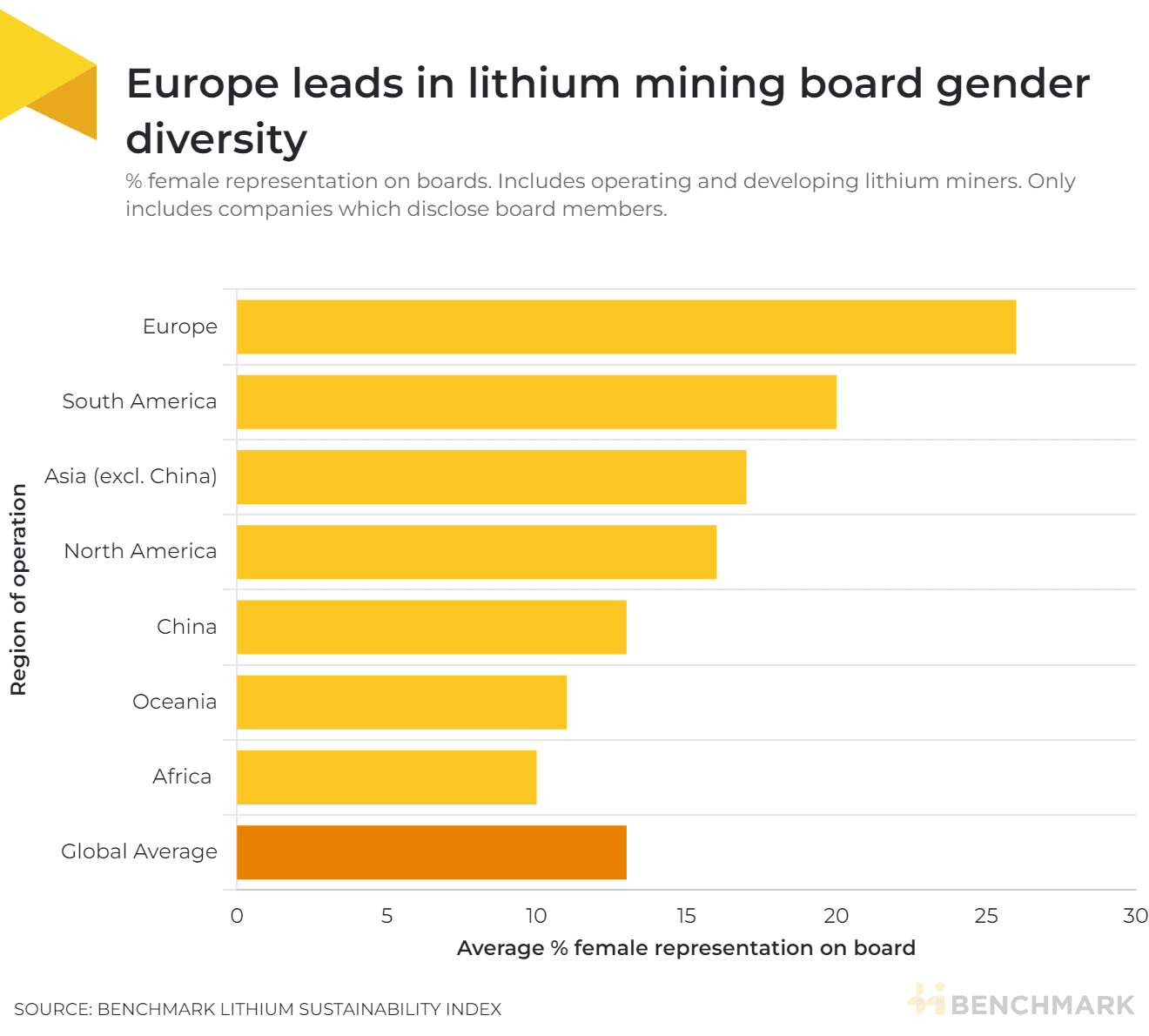
OceaniaandSouth Americaare the world’s largest lithium producing regions, representing 40% and 33% of mined lithium supply in 2023. However, companies operating or developing lithium projects in Oceania had an average of just 11% gender diversity on their boards compared to 20% in South America.
Lithium mining companies withAfricanprojects had the lowest gender diversity with the average board comprising just 10% female representation amongst those that disclose their board members.
TheUnited Nations has Gender Equalityas one of its Sustainable Development Goals. Policy at the country and regional level can help progress towards this goal.
The European Union has mandatory gender diversity quotas as part of its Gender Equality Strategy. In 2022, as part of this strategy, the bloc approved a directive on gender balance on corporate boards.
The directive states that by 2026, listed companies in Europe should “aim to have members of the underrepresented sex” holding at least 40% of non-executive director positions or 33% of all director positions.
Gender diversity is a key part of broaderenvironmental, social, and governance(ESG) aims.
“Though we see a focus on carbon, that’s not to say it should be–or is–the primary focus of the industry and supply chain from a sustainability perspective,” Colbourn said. “We have reflected this in our Sustainability Indexes whereby no weightings are currently applied to different sub-components.”
 >
>  >
>  >
>  >
>  >
>  >
>  >
>  >
>