Donald Trump wins US election bringing future of IRA into question
Donald Trump has regained control of the White House after beatingKamala Harrisin the USelectionthis week. Republicans have secured a majority in the Senate and are currently winning the race for the House of Representatives.
Having a majority in both houses strengthens Trump’s ability to repeal more legislation, including parts of President Biden’s signatureInflation Reduction Act (IRA).
“Trump’s return to the White House is likely to result in a pivot towards fossil fuels and a relaxation of environmental regulations,” said Bryan Bille, a policy analyst at Benchmark.
Could Trump repeal the Inflation Reduction Act?
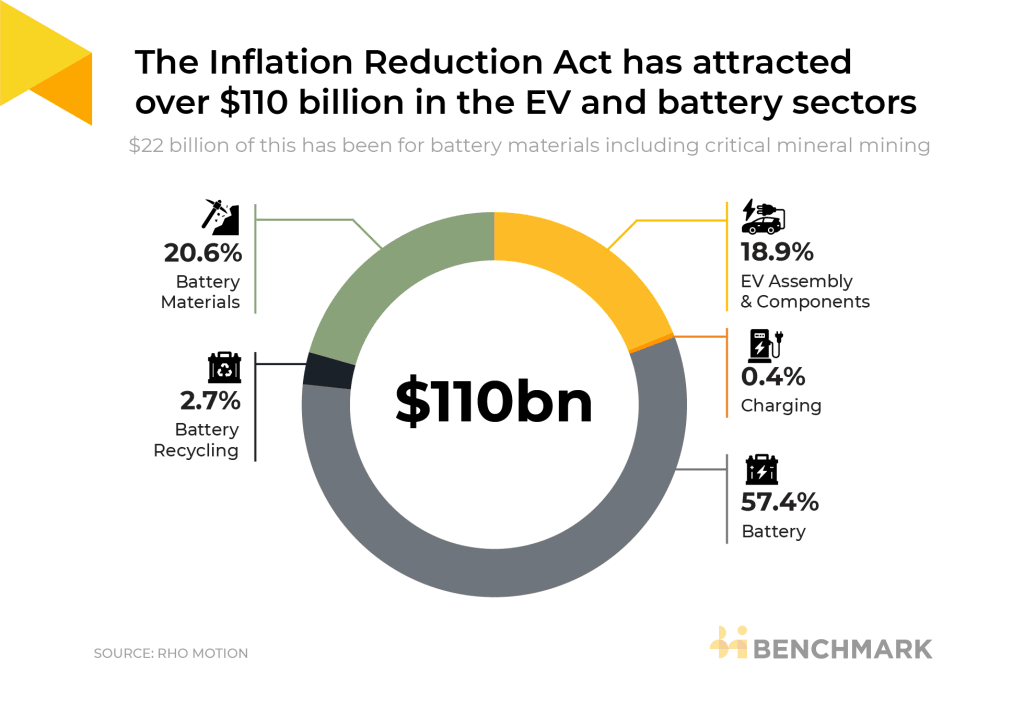
Since President Biden enacted the IRA in August 2022, more than $110 billion of investments have flowed into the electric vehicles and battery sectors, according to data from Rho Motion.
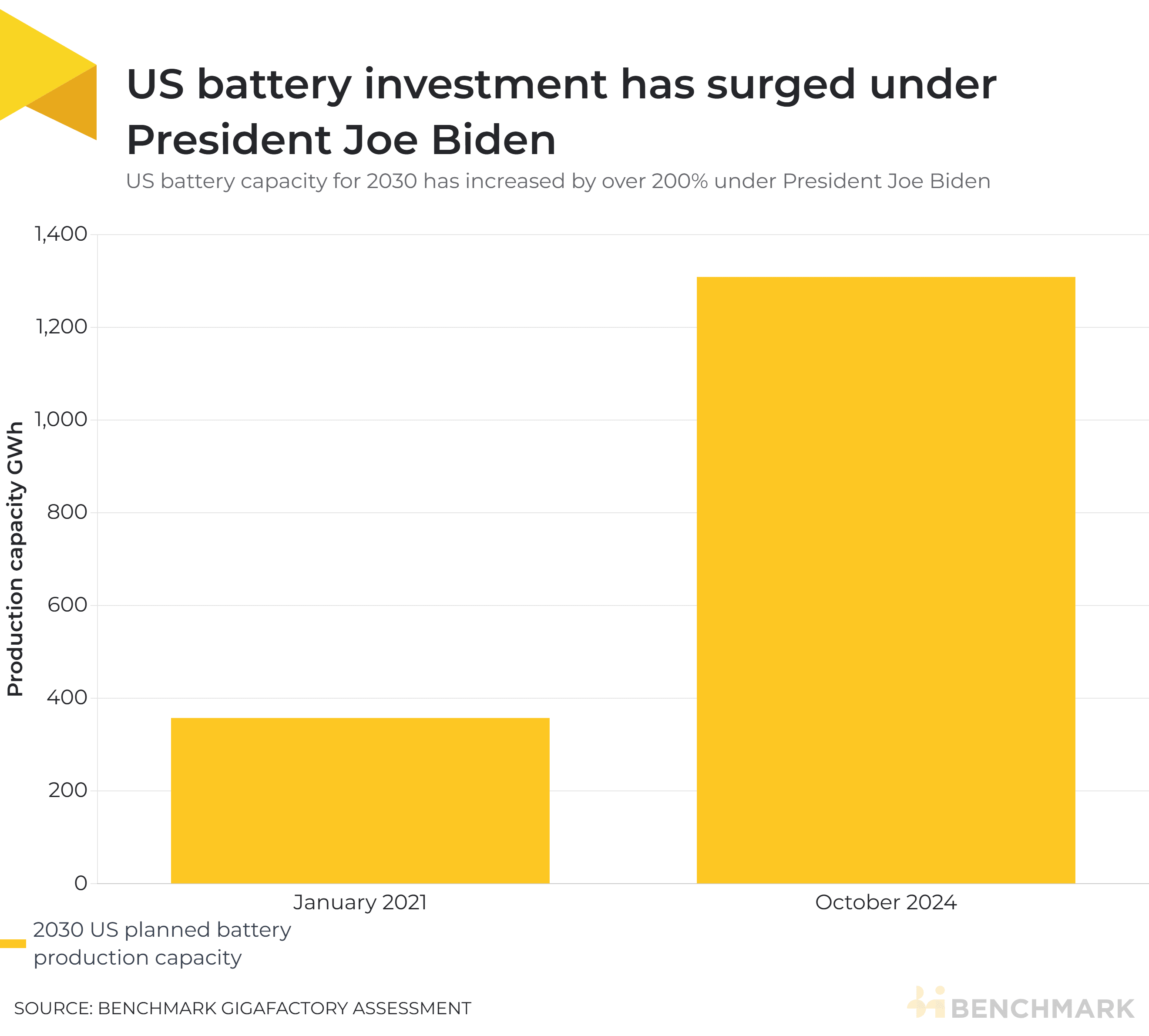
The success of the IRA can be seen in the2030 gigafactory pipeline. At the start of Biden’s presidency it sat at around 360 gigawatt-hours. Today the 2030 pipeline is more thanthree times the sizeat 1,310 gigawatt-hours, according toBenchmark’s Gigafactory Assessment.
Trump has repeatedly expressed a wish to repeal parts of the IRA, especially those parts favouring EVs.
“Donald Trump has reportedly promised to scrap pro-EV rules, mandates, and has regularly criticised the IRA’s tax policy, especially Section 30D, which provides tax credits,” Bille said.
Although Trump looks on track to have control of both the House and the Senate, he may face push back from within his own party if he pushes too hard against the IRA.
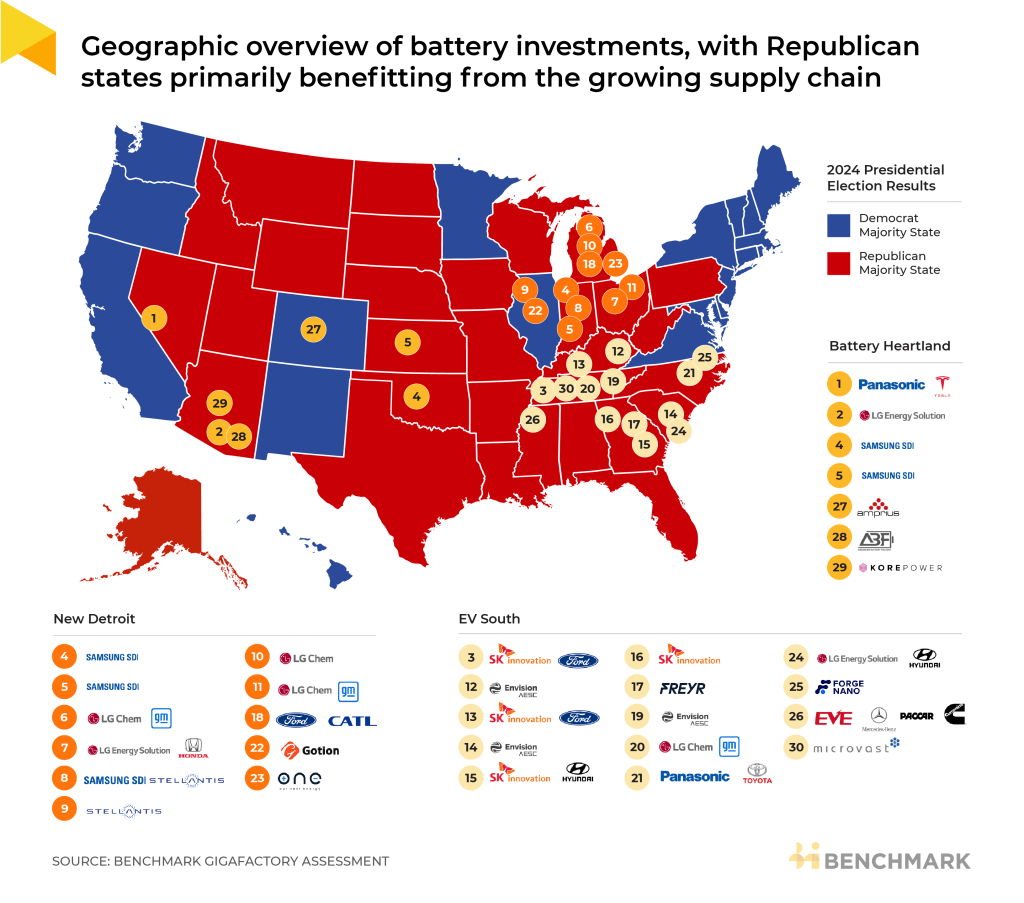
“Mainly Republican states have significantly benefited from clean tech investments resulting from the Inflation Reduction Act,” Bille said. “Watering down or cancelling these investments would affect the US’ catch up efforts vis-a-vis China.”
IRA investment flowed primarily into Republican states, with this proportion growing following the election results. Up to 92% of IRA investments are now in red states (including states yet to declare but looking likely to vote Republican).
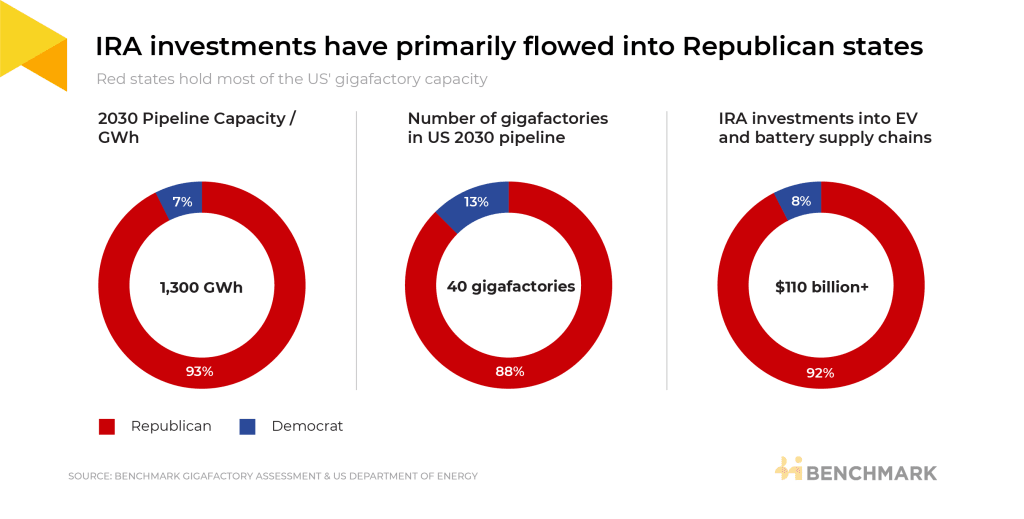
Of the 1272 GWh in the pipeline to 2030 in the US, 876 GWh is planned for Republican states, with over 300 GWh of capacity sitting in states yet to be called. Should all this capacity go ahead it marks $81.5 billion in investments and thousands of jobs for those regions. Notably Texas, a republican stronghold, has the largest pipeline capacity of all US states, according toBenchmark’s Gigafactory Assessment.
Without control of both houses, it is unlikely that Trump could repeal parts of the IRA nor the Bipartisan Infrastructure Law. That said, Trump could still change the implementation of the IRA, according to Bille, such as changing foreign entity of concern (FEOC) rules.
What is Trump’s view on mining?
Although Trump is not in support of the IRA,domestic critical mineralproduction is likely to still have a place.
“Trump voiced his support for domestic mining, which could result in a more profound permitting reform and further financial support for domestic mining projects,” Bille said.
What does Trump’s win mean for US-China relations?
Earlier in 2024, Biden added100% tariffs to imported Chinese EVsand alsoincreased the tariffson Chinese critical minerals. Trump’s win will likely see more tariffs imposed on Chinese imports.
Further, the FEOC rules of the IRA currently only apply for the 30D tax credits when consumers purchase an EV. Bille says Trump could strengthen these and potentially extend them to apply to the45X production tax credits.
“There is an expectation of more domestic and foreign policy uncertainty and turbulence,” Bille said.
Watch Benchmark’sfree videoon what Trump’s victory could mean for EV and battery supply chains.
What does this mean for electric vehicles?
Since the implementation of the IRA, EV sales in the US have been steadily growing with penetration rates currently around 10% of new sales, according to Rho Motion.
There was a dip in sales when the first FEOC restrictions came into play at the start of 2024 as several models became ineligible for 30D tax credits. However, these sales have since recovered.
Despite Trump’s aversion to EVs, Bille says it is notable that Elon Musk–the chief executive of Tesla, the US’ largest EV company–is a staunch supporter of Trump.
Future demand for EVs was supported by the Biden administration strengthening the environmental protection agency (EPA) emissions standards that had been reduced during Trump’s first presidency.
Trump has expressed an ambition to roll back these emission reduction standards. Such changes would reduce demand for EVs. However, making such changes won’t come quickly.
“Rolling back these standards takes time, typically, years,” Bille said. “Moreover, another thing to remember is that some federal states have already implemented stringent emission standards and EV adoption programs beyond federal control.”
Join us at Benchmark Week for critical sessions likeUS Election Aftermath: Policy and Industry Implications,Navigating the US Policy Landscape, andMESC Grants: Boosting the US Domestic Battery Supply Chainto gain insights into the policies shaping the market post-election.
Benchmark Week returns to Los Angeles on 12-14 November 2024, bringing global industry leaders, financiers, and government officials together to chart a course for the technologies and supply chains central to the energy transition.
Stay informed about potential changes in the industry and be part of the discussions that will define the future. View the agenda and secure yourticket here.
 >
>  >
>  >
>  >
>  >
>  >
>  >
>  >
>