Can the EU meet its proposed battery metals recycling targets?

Towards the end of 2022, the European Parliament and Council provisionally agreed on legislation to regulate the full lifecycle of a battery to improve circularity and sustainability.
Included in the regulations are recovery and collection targets, and mandatory minimum targets for how much of a new battery’s raw materials should come from recycled sources.
YetEurope may struggleto produce sufficient recycled lithium or cobalt by the end of the decade to meet these targets, according to an analysis by Benchmark, without an increased build-out of recycling capacity andimprovements in the technologyto recover lithium.
“I think it’s ambitious,” Sarah Colbourn, an analyst at Benchmark, said. “But it’s a necessary step to incentivise recyclers and investors into this space.”
Meeting mandates
The regulations are part of the European Green Deal and were updated in December 2022 to make some of the targets more ambitious thanpreviously proposed.
The new mandated targets for recycled lithium, nickel, and cobalt contained in lithium ion batteries sold in the EU will start at 6% for lithium and nickel and 16% for cobalt in 2031, if the legislation is passed this year.
These will rise to 12% for lithium, 15% for nickel and 26% for cobalt in 2036 (or 13 years after the legislation is passed).
By 2031, Benchmark forecasts Europe’s battery cell demand to be 958 gigawatt hours. To meet the mandatory 6% target will require around 42,000 tonnes of recycled lithium (lithium carbonate equivalents).
Globally, recycled lithium is set to make up around 10% of the lithium supply in 2031, rising to over 20% in 2036, according to Benchmark’s Lithium Forecast.
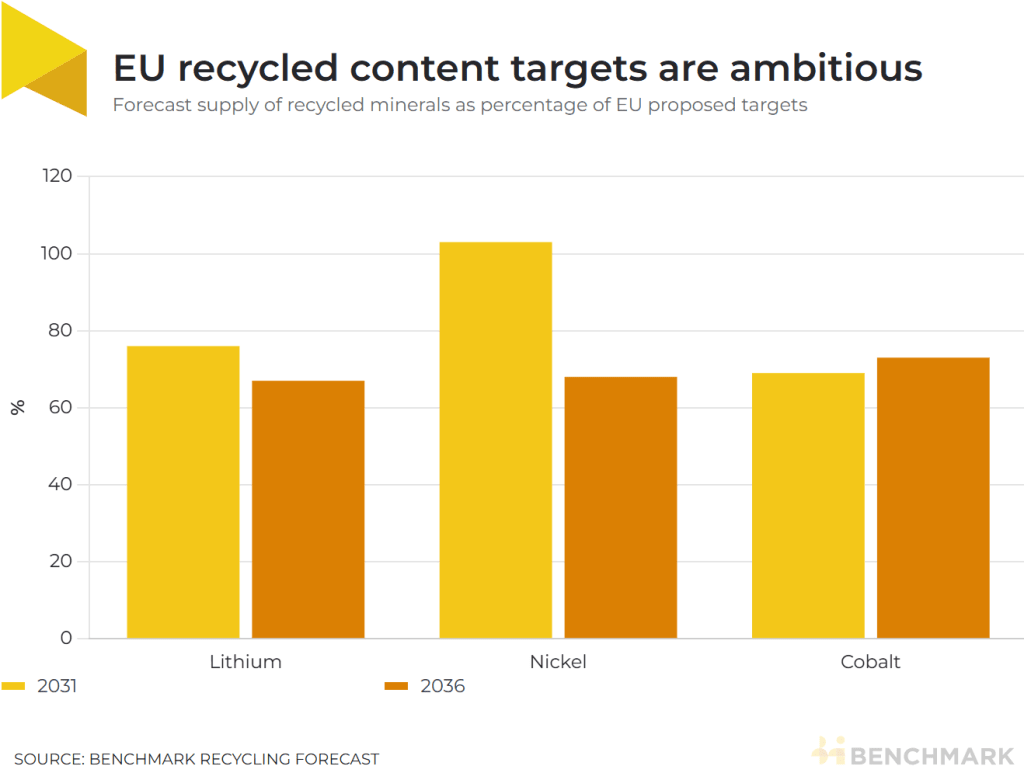
However, Benchmark’s Recycling Report forecasts that Europe will only produce just over three-quarters of the required recycled lithium to meet this mandate in 2031. For cobalt, the region is expected to produce just under 70% of the required recycled material.
Nickel is the only recycled metal currently forecast by Benchmark to be produced in sufficient quantities to meet Europe’s target.
In 2036, Benchmark forecasts that Europe is not on track to produce enough of any of the metals to meet the increased minimum requirements.
Improving recovery rates
That is not to say the targets are impossible.
Beyond the minimum recycled content targets, the new regulations also set out targets that recyclers should recover 50% of the lithium in a battery in 2027, increasing to 80% in 2031. For nickel and cobalt, this target is 95%.
If the EU’s recycling industry hits these targets, Benchmark’s analysis shows there is sufficient lithium, nickel and cobalt contained in the bloc’s end-of-life andprocess scrappools to meet the minimum recycled metal targets. This will require more capacity to be brought online.
“Looking to the early 2030s, Europe’s scrap pool will have grown significantly in comparison to today’s pool,” Colbourn said. “This offers Europe the availability of recycling feedstock required to meet targets for lithium, nickel, and cobalt.”

However, the majority of recycling in Europe currently uses pyrometallurgical processes. Colbourn explained that this is good for recovering nickel and cobalt, but the lithium ends up in the waste slag.
Achieving an average of 80% lithium recovery by 2031 will require significantly more capacity to be built using hydrometallurgical technologies which can recover lithium.
“There are drives in technology to improve lithium recovery, with more recyclers advancing hydrometallurgical processes that promise higher recovery rates for the material,” Colbourn said.
Many European facilities in the recycling value chain in Europe currently focus on the pretreatment of scrap batteries at the moment, producing black mass as an intermediate product, rather than battery-grade material, Colbourn said.
Developing a collection ecosystem
The legislation also introduces collection rates for end-of-life batteries, with the EU targeting the collection of 73% of used portable batteries by 2030 and 61% of used batteries used for light mobility applications such as e-scooters by 2031.
Cesar Santos, a policy officer at the European Commission, said in September at the 2022 International Congress for Battery Recycling that the legislation contains an implicit target of 100% collection of end-of-life EV batteries.
“End-of-life battery collection is one of the challenges that the recycling industry faces, requiring coordination from policymakers, through to battery producers and end consumers,” Colbourn said. “Recent moves from governments, including the EU, to introduce extended producer responsibility rules, which define who is responsible for lithium ion battery recycling, is critical for building out a recycling ecosystem.”
Currently, the collection of portable batteries is a long way off the EU target, according to Colbourn.
The majority of end-of-life battery waste will come from electric vehicles. An ecosystem needs to develop if the EU is to source all the end-of-life batteries required to meet its targets.
One way for recyclers to get hold of end-of-life batteries is topartner with an automakerorbattery producer.
“Utilising existing networks of automakers to collect EV batteries, and partnering with lithium ion battery recyclers, helps overcome some of the hurdles associated with the logistical challenges of battery recycling,” Colbourn said.
Analysis by Benchmark shows that the mandated minimum recycled metal targets can be met if both the overall collection rate of batteries and the recovery rates of metals in the recycling processes are improved, assuming there is sufficient capacity to process the end-of-life batteries.
“Meeting these targets is dependent on collection infrastructure, recycling capacity, and technology capabilities all being in place to facilitate substantial recovery of metals,” Colbourn said.
 >
>  >
>  >
>  >
>  >
>  >
>  >
>  >
>