Nobel laureate Stanley Whittingham on the future of lithium ion batteries
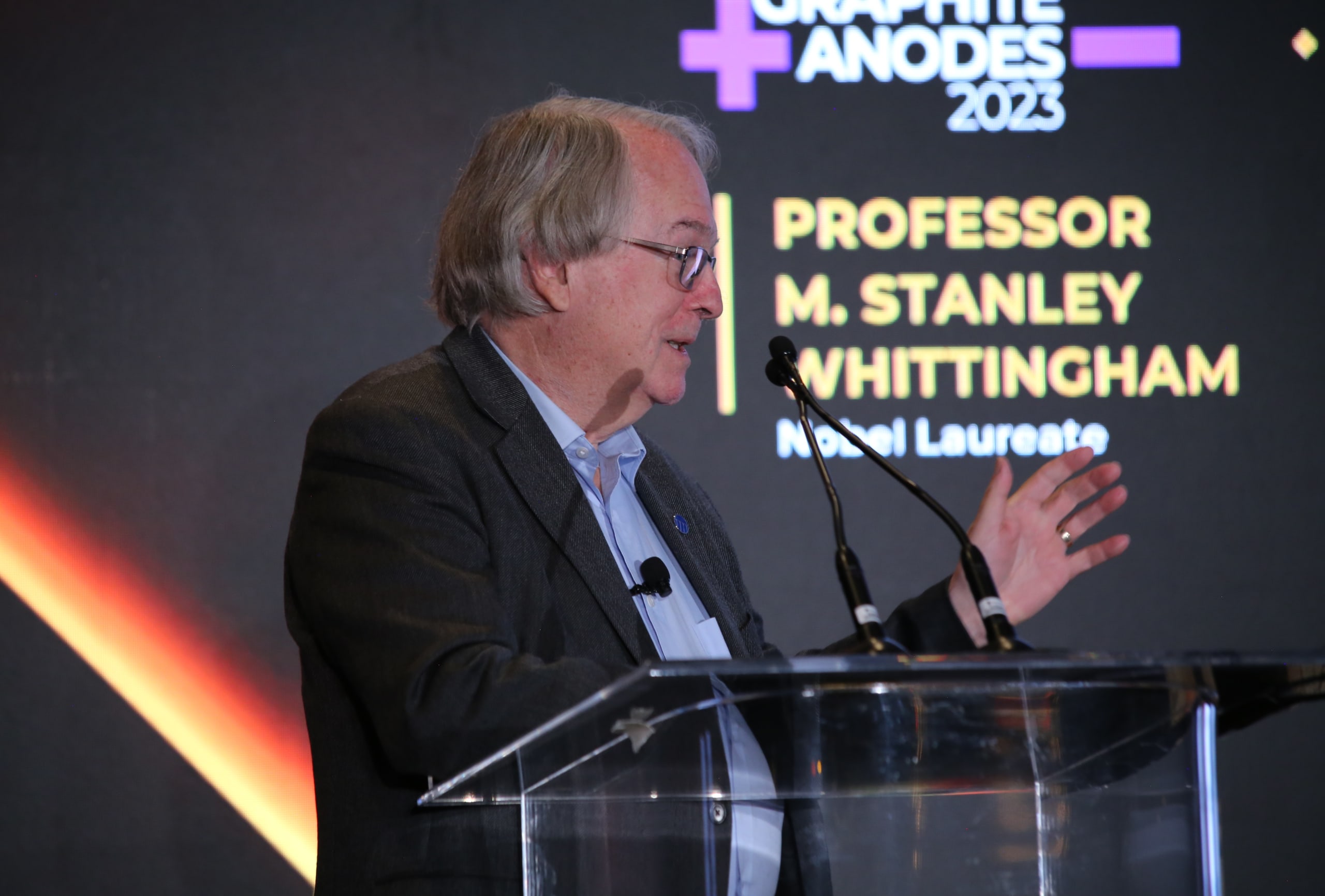
Professor Stanley Whittingham was awarded Benchmark’s Lifetime Achievement Award atBenchmark Week 2023conference in Los Angeles.
Whittingham won the Nobel Prize in chemistry in 2019 alongside Akira Yoshino and John Goodenough for his work on the development of lithium ion batteries.
Here are some key takeaways from his talk:
Battery technology:
Whittingham shared with the audience what he believes will be the next evolution for batteries.
“I think the next step is to go from lithium ion to lithium (metal), and that’s what a lot of our goals are. So if we can double the energy density in the present batteries, that will automatically cut the cost by at least 50%” he said.
Whittingham is part of a consortium funded by the Department of Energy that aims to increase the specific energy of lithium ion batteries to 500 Wh kg, with 1,000 charge/discharge cycles.
“Today we’re at about 1,000 cycles at 350 wh/kg,” he said.
The addition of manganese can boost the voltage of LFP cells, while other materials such as vanadyl phosphates are also being looked at to increase energy density, he said.
In the future, lithium sulphur cells could also double the energy density of current lithium ion batteries, and is the “lowest cost of all systems,” Whittingham said. “That would be a huge breakthrough; it would have much higher energy density on a weight basis.”
On sodium ion technologies, Whittingham said the cost was potentially an issue.
“There’s lots of interest in sodium, but if you do technical work on sodium, make sure you do the economics at the same time, it’s not clear that sodium ion will be any less expensive, it may even be more expensive,” he said. “Because the energy density is one half so it’s going to be twice the size, twice the weight. The only advantage is can you take all the cobalt out and nickel out by using a manganese iron cathode.”
“There’s incentives for sodium but don’t expect sodium to come roaring and take out the field in the next two or three years.”
Whittingham saidsolid-state batterieswill be at least five or ten years out.
“No evidence today that solid state is any safer than today’s liquid electrolyte batteries, despite what you may read … 95% of everything you read in the popular press is hype.”
Regional supply chains:
The US should work with Canada to build a regional supply chain for batteries and has “everything it needs” to build cheaper lithium iron phosphate (LFP) cells, Whittingham said.
“We have lithium in this country, we have iron in this country, we have phosphorus in this country and we clearly have lots of oxygen. So we have everything we need in North America to make LFP.”
That will involve the US working with Canada on the extraction of raw materials for batteries, he added.
“I’ve been trying to convince Washington, with some success, to talk about North America and stop talking about the US. Because we have a lot of clean energy in Canada, we have nickel, and graphite in Canada, and they’re our friends. So let’s work more closely with them.”
Improving battery production:
Production of lithium ion batteries also needs to become cleaner, by removing the use of solvents such as NMP as well as cutting down on the energy used, he said. Battery production needs between 40 to 80 kWh to make a 1 kWh battery, he said.
“We need to build here to supply our own needs. We don’t necessarily need to exclude China totally, there’s some things they can do for us. But we need to have our own industry, the cost will be less, both dollars and environmental, if we do it ourselves,” he said. “We can’t have all our industry just disappearing like it has done for the last 30 to 40 years.”
“We have to have cells that can recycle and we’ve got to make sure the cells are safer. That doesn’t necessarily mean changing the chemistry. It means making them in a better way.”
To learn more about Benchmark and any of its services, please provide your details here:
 >
>  >
>  >
>  >
>  >
>  >
>  >
>  >
>